

Singapore is an emerging market in the fashion industry. By the end of this year, the fashion segment was projected to reach $1.76bn and have an expected revenue growth rate of 16.39%, skyrocketing the revenue to $3.76bn by 2027 (Statista, 2022). Not only is the market doing exceptionally well, but it is doing well for the environment too.
About Singapore
In the decade post World War II, people in Singapore wore traditional attire daily. Women had the opportunity to get their feet into the workforce during the war, which gave them more spending power. The post-war media of television and magazines encouraged Malayan women to turn towards Western fashion trends (Yeo, 2017).
Fashion Mirror was a popular publication in Singapore that focused on local fashion that had root influences from the Western culture. A feature included an outfit known as the “samfu” but with enhanced materials.
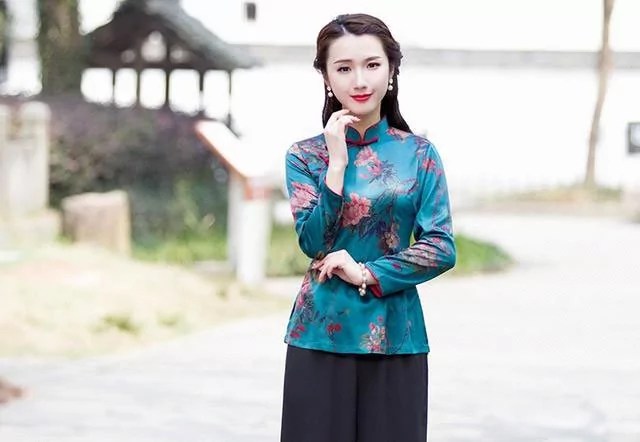
A samfu is a traditional female costume consisting of a blouse and trousers. The difference in the 1950s is that modern fabrics were used.
By the 1970s, Japanese department stores with ready-to-wear outfits became very popular. Moving along to 1983, a newspaper reported that “Singapore-made apparel had led to a $20-million increase in exports for the first eight months of the year, raking in more than $1.1 billion worth of sales for the year” (Strait Times, 1983).
Singapore stands as the fashion capital of Asia, holding annual fashion shows. In 2011, Herworld shared that Singapore ranked one above Tokyo to take the number 8 spot on the fashion capitals in the world (Adminhw, 2011).
The Problems with Fashion in Singapore
Singapore is a business hub in central Asia with people who’s favorite hobby is to shop. With the demand for shopping, there must be supply that accompanies it. Singapore’s fashion and textile products account for 137,000 tons of waste, and of this large number, only 4% is recycled (Baker, 2022).
The brand Shein is a large factor in this waste – contributing thousands of styles through fast fashion. It’s brand headquarters is based in Singapore, although it was created in China. Consumers in Singapore rather quantity over quality when it comes to their clothing items. They are cheaply made and continues to gain popularity. Therefore, “Established relationships with manufacturers allow SHEIN to produce lower minimum quantities at a rate faster than their competitors” (Mothership,2022).
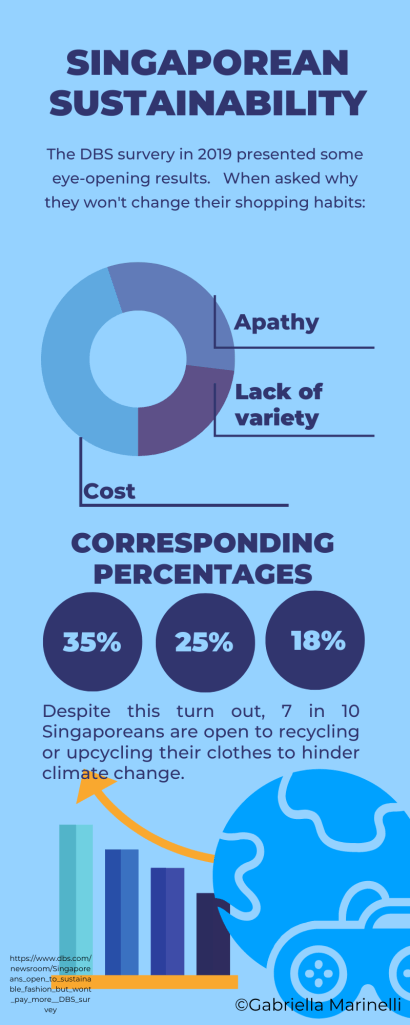
According to a DBS survey in 2019, 60% of respondents were fully aware that fashion is the biggest contributor to global pollution. This is a major problem in itself that people know their actions are harming the environment and continuously take part in it. Younger audiences have picked up on this and started to try to find solutions.
How Singapore is fixing the issue
Singaporeans are slowly beginning to address the issue. The Singapore Green Plan is a nation-wide movement to advance Singapore’s sustainable development. The key plan targets include:
- Plant 1 million more trees
- Quadruple solar energy deployment by 2025
- Reduce the waste sent to landfills by 30% by 2030
- All newly registered cars to be cleaner-energy models from 2030
That is not all of the goals, but some benchmarks that the capital is working towards. Some of the best ways to see this in action is to use recycled cotton and eco-friendly packaging.
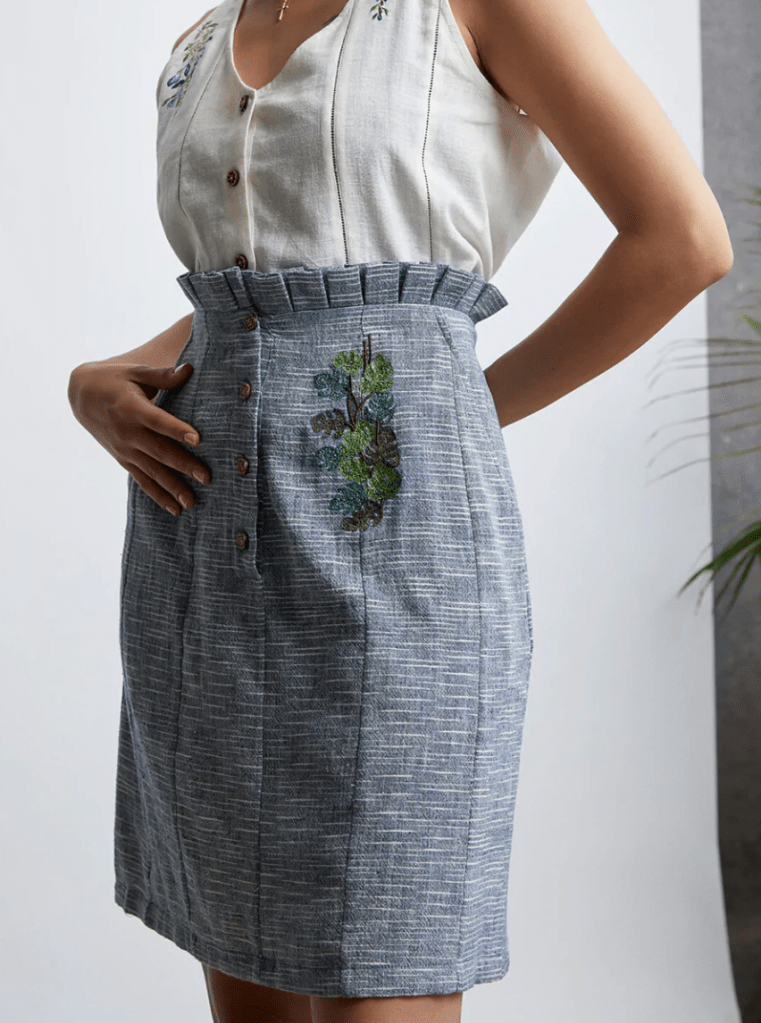
In one of my recent blog posts, I discussed the advancements of cotton in the fashion industry. Native Singaporean brands like Sui is truly tuning into their sustainability by using organic cotton to create their pieces. For example, this skirt is made completely with handwoven organic cotton; however, its price does reflect it. I believe it is worth the price because of its ability for long term use.
The Textile and Fashion Federation launched a fashion sustainability program to benefit the local fashion industry. There is a Fashion the Change activation which displays creations made from recovered and repurposed materials. Along with this, the Take Back campaign encourages people to reuse and donate clothes to those who will use it.
Influence among other fashion capitals
Not only is Singapore worried about the consequence of climate change on their own country, but also on a global scale. In 2020, Singapore promised the UN that they would lower carbon emissions by 16%, and they achieved this goal and ended up being 32 percent below (NCCS, n.d.).
Singapore invested themselves into co-operational climate change actions. This pushed for other countries in the UN to make changes to their climate change plans and do what is best for the global environment. Singapore is a key partner to many countries and regions to ensure their goals are being met in many locations.
Although there were rough finds in surveys with how Singaporean citizens were reacting to the knowledge of the affects of their purchasing power on the environment, it is important for all countries to note how important taking initiative is and the lasting effects it has on the Earth.
Ultimately, Singaporeans are able to become more conscious about their purchase decisions while being offered a diverse variety of fashion trends from homegrown brands.
References
Adminhw. (2011, September 11). Is Singapore really a fashion capital, or just a shopping one? Her World Singapore. Retrieved November 30, 2022, from https://www.herworld.com/fashion/singapore-really-fashion-capital-or-just-shopping-one/#:~:text=Singapore%20is%20purportedly%20one%20of,number%20eight%20%E2%80%93%20one%20above%20Tokyo
Baker, J. A. (n.d.). ‘normalise re-wearing clothes’: Experts urge consumers to reduce impact of fashion on environment. CNA. Retrieved November 27, 2022, from https://www.channelnewsasia.com/singapore/clothes-swapping-rental-fast-fashion-environment-impact-2392311
Halim, C. R. (2022, March 25). What’s The Future of Sustainable Fashion in Singapore? Her World Singapore. Retrieved November 27, 2022, from https://www.herworld.com/fashion/shopping/sustainable-fashion-pandemic-singapore/
How do fast fashion brands like Shein Affect s’poreans’ pursuit of a sustainable future? Mothership.SG – News from Singapore, Asia and around the world. (n.d.). Retrieved November 30, 2022, from https://mothership.sg/2022/07/fast-fashion-shein-sustainability-singapore/
Fashion – singapore: Statista market forecast. Statista. (n.d.). Retrieved November 30, 2022, from https://www.statista.com/outlook/dmo/ecommerce/fashion/singapore
Singapore and international efforts. NCCS. (n.d.). Retrieved November 30, 2022, from https://www.nccs.gov.sg/singapores-climate-action/singapore-and-international-efforts/
Singapore green plan 2030. Singapore Green Plan 2030. (n.d.). Retrieved November 27, 2022, from https://www.greenplan.gov.sg/
Singaporeans open to sustainable fashion but won’t pay more: DBS survey. (n.d.). Retrieved November 30, 2022, from https://www.dbs.com/newsroom/Singaporeans_open_to_sustainable_fashion_but_wont_pay_more__DBS_survey
The Singapore cut ropes in $20m more. (1983, October 22). The Straits Times, p. 15. Retrieved from NewspaperSG.
The way we were: Fashion through the decades. BiblioAsia. (n.d.). Retrieved November 30, 2022, from https://biblioasia.nlb.gov.sg/vol-13/issue-3/oct-dec-2017/fashionthroughdecades#fnref:16
 Gabriella Marinelli